Parent Resources
Parents of children with autism often navigate complex safety considerations that go beyond typical childhood risks. Understanding and preparing for challenges can make all the difference in creating secure environments at home and in your community. This page outlines a few important risk management strategies.
Written by Nazanin Ainy
M.ADS BCBA, RBA (ONT.)
Most parents place their children’s safety at home and in the community as a top priority. But for parents of children with autism spectrum disorder (ASD), it can be more challenging to keep them safe. Risk of accidents, injuries, death or harm by others such as familiar people or strangers, to individuals with ASD, have been consistently documented in the applied behavior analysis (ABA) literature (Guan & Li, 2017; Gunby, Carr & LeBlanc, 2010; Johnson et al., 2005; Kenny, Bennet, Dougery & Steele, 2013; Volkmar & Wiesner, 2009; Wurtele, 2009).
Abduction Prevention / Safety Awareness
One type of important safety skill for parents to teach to their children is safety awareness. Children with ASD usually require direct and explicit instruction on safety skills and an emphasis should be placed on applying these skills to real life situations. Safety awareness is teaching children to be alert in various places and situations and to remain safe. Children need to practice responding to tactics called a “lure” in the literature. A lure is something that attracts someone to a dangerous situation. In response to a lure from a stranger it is crucial to teach the child the three steps of safe responding: (1) say “NO” or say any refusal statement; (2) move away from the stranger within 3 seconds; and (3) immediately report the incident to a trusted adult (such as parents, teacher, security guard, etc.).
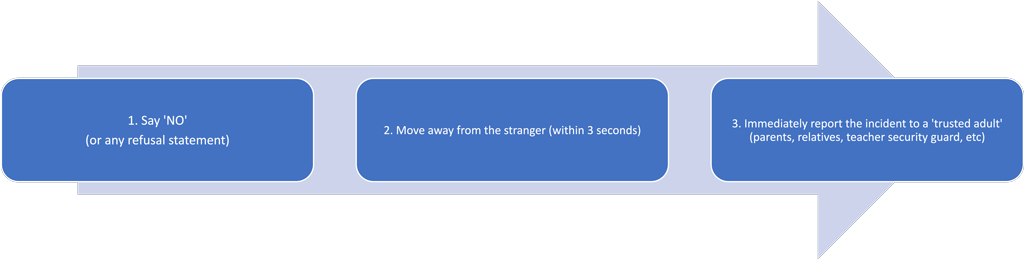
The following scenarios represent the types of lures that a stranger may use in an attempt to separate the child from a protective location or the care of known adults:
- General Lure, The stranger directly asks you to leave with them (e.g, “Will you come with me?”)
- Authority Lure, The stranger imitates an authority figure (e.g., “Your mom asked me to pick you up”)
- Incentive Lure, The stranger tries to offer you something (e.g, “I’ll buy you ice cream if you come with me”)
- Assistance Lure, The stranger asks for your help (e.g, “Can you help me find my puppy?”)
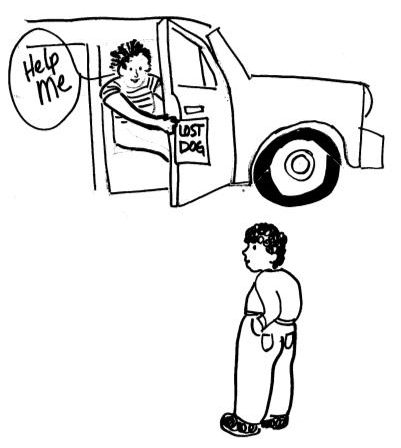
From Wurtele (2007), with author’s permission
The Body Safety Training Program by Sandy K. Wurtele (2007), is an easy to use education program aimed at ensuring children are informed about their body and acquire self-protection skills. In the body safety training workbook for parents, Wurtele (2007) has provided visual pictures that are easy to understand. For example, one picture shows a scenario where a stranger stops their car and asks the child for help. The workbook explains to parents how to teach their children to say “NO!”.
Safety training as described in The Body Safety Training Program involves first teaching the child the rationale behind safe responding and presenting a lesson with pictures on how to stay safe. Second, the parent should model the safe behavior, and allow the child to practice. The parent provides the opportunity to role play at home or wherever the child usually has lessons. Feedback should be provided for both correct and incorrect responses. For example, “You moved away, right away and looked for a teacher. That was great!” or “You said “NO”, but you didn’t move. You need to move away right away”. It is necessary to set up practice opportunities in the community without the child being aware that the situation is contrived, not real, so that the child can independently practice the safety skills. Every time the child exhibits the safe skills correctly, parents should provide positive remarks or provide what the child likes, to encourage them to continue with the correct safe responding. It can be scary for parents to stand back to allow their child the opportunity to experience moving away from strangers, but realistically it’s difficult for parents to always be with their child. It is in the best interest of both the child and parent that the child learns to be independent and to act and respond correctly in unsafe situations.
Childhood Sexual Abuse (CSA) Prevention
Although CSA can affect any child, children with ASD may be at greater risk for victimization. There is also research that points to the need to teach safety skills to children as young as 5 years-old (Merrill et al., 2001). The safety of children is a concern for their parents, professionals, and for all of society. Lessons to reduce the risk of sexual abuse include teaching children about their body parts, their genitals (specifically correct body part terminology) in males and females, discrimination between appropriate and inappropriate behaviors, verbal and physical refusal, and reporting skills. Some parents may encourage their children to use euphemisms such as “weenie, pee-pee, down there, or the business”. Learning the correct terminology for their genitals is important because it helps children to report abuse. Children using the correct terms can also scare off a potential abuser who will realize the child is knowledgeable and capable of reporting abuse.
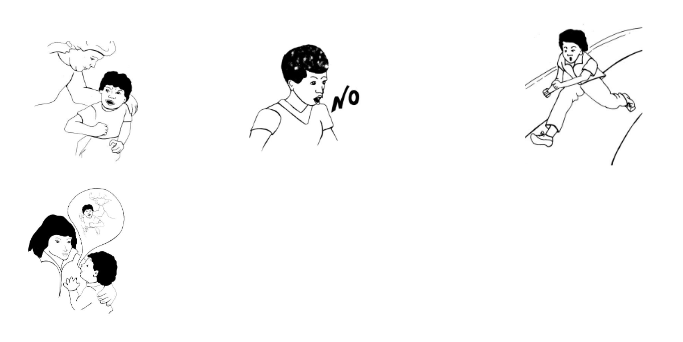
From Wurtele (2007), with author’s permission
In response to an inappropriate behavior or touch from a familiar person or a stranger it is important to teach the same three steps of safe responding that would be made to an abduction attempt: (1) say “NO” or say any refusal statement; (2) move away from the stranger within 3 seconds; and (3) immediately report the incident to a trusted adult (parents or trusted adult, teacher, doctor, etc.). It is essential to teach what are appropriate and what are inappropriate touches, and that doctors, nurses and parents may need to touch a child’s private parts to help them when they are hurt. As well, parents may need to help them wash or wipe their private parts. It is also important to teach the child that they are in control of their body and to teach them how to protect themselves and keep their body safe.
Another factor that parents should be aware of is that early intervention for children with ASD often emphasizes compliance training because the ability to comply is considered to be a necessary skill for success in the classroom. While learning to follow rules and to follow an adult’s instructions are important, children may not have the opportunity to learn that there are times when they can and should say “NO”. Their parents should explicitly teach them using multiple examples of when they should say “NO”. As well, parents can’t just talk to their child about saying “NO”, the child needs to actually practice saying “NO”, with several people and in several contrived situations. Parents should also teach their children that their body belongs to them. Often times children will be told to “always listen to your teacher or babysitter, etc.”
With all the instructions to listen and comply it becomes crucial to teach that their personal safety is more important than cooperating in certain situations. Parents or practitioners should teach many varied examples of scenarios that could put the child’s safety at risk and teach them that it is okay to say “NO’ in those situations. Again, it is critical that the child is taught with role play and taught to actually engage in saying “NO” during the safety training.
Another important point is that parents need to be mindful about teaching the importance of privacy. For instance, violating a child’s privacy by walking in on them without knocking while they are dressing or using the toilet might inadvertently teach the child that they do not have a right to privacy. Therefore, establishing rules at home about respecting individual rights to privacy in dressing, bathing, and sleeping is essential. As well, safety awareness and training should start at an early age, and it can simply start by teaching a child to dress in private and not to dress in front of others.
Relationship Boundaries
It is important for parents to teach their children about relationships and boundaries and how to interact with different people based on whether they are family, friends, community helpers (teachers, doctors, police officers, etc), acquaintances, or strangers. For example, children can only invite family and close friends to their homes and can only share personal information with those family members and close friends. Children should not interact with strangers at all. Parents and other trusted adults must also adhere to the relationship rules to set a good example. It is also vital for children to learn who to go to for assistance, and who is a trusted adult when they need to report an unsafe situation. For example, it’s okay for a child to go to a police officer or a security guard to report an incident, but they shouldn’t go to a stranger. Children can be taught that police officers and security guards are recognized by their uniforms and their role is to protect community members.
Children who don’t yet have the language skills to work through The Body Safety Training Program (Wurtele, 2007) can still benefit from discrimination training to learn what types of interactions, e.g. hugging, kissing, high five, playing together, or keeping a distance, are right for which types of relationships. First, types of relationships need to be taught. Pictures of family members, friends, teachers, trusted community helpers, and strangers can be sorted into their respective groups. Then, pictures of interactions such as hugging can then be matched to the family pile, while a picture showing two people very far apart could be matched to the stranger pile, and so on. It is also crucial that when the child gets too close to a non-family member, he or she is told he is too close and prompted to move away. As role models of non-family members, teachers and therapists should gently block attempts by the child to hug or come too close.
Parents play an important role in teaching safety skills. Children with ASD are particularly vulnerable to unsafe situations but be assured that research has shown that these children can learn these safety skills. The Body Safety Training Workbook by Sandy K. Wurtele (2007) is an excellent resource for parents to guide them in their safety training with their children. There are two versions of the body safety-training program workbook; one designed for parents and one for professionals. The body safety training program also covers lessons on poison and fire safety, being alone at home, lost in a store rules, car and traffic safety, and exercises to practice with your child. For additional support you can contact a behaviour analyst to implement a safety program.
For urgent and immediate concerns please contact your local children’s aid society or 211 Ontario, depending on the nature of the concern. The following website is also available to guide you to the right services http://www.findhelp.ca.
References
- Guan, J., & Li, G. (2017). Characteristics of unintentional drowning deaths in children with autism spectrum disorder. Injury Epidemiology, 4(32), 1-4.
- Gunby, K. V., Carr, J. E., & LeBlanc, L. (2010). Teaching abduction prevention
- skills to children with autism. Journal of Applied Behavior Analysis, 43, 107–112.
- Johnson, B.M., Miltenberger, R.G., Egemo-Helm, K., Jostad, C. J., Flessner, C., & Gatheridge, B. (2005). Evaluation of behavioural skills training for teaching abduction-prevention skills to young children. Journal of Applied Behavior Analysis, 38, 67-78.
- Kenny, M. C., Bennett, K. D., Dougery, J. & Steele, F. (2013). Teaching general body safety training skills to a Latino preschool male with autism. Journal of Child and Family Studies, 22, 1092-1102.
- Merrill, L. L., Thomsen, C. J., Sinclair, B. B., Gold, S. R., & Milner, J. S. (2001). Predicting the impact of child sexual abuse on women: The role of abuse severity, parental support, and coping strategies. Journal of Consulting and Clinical Psychology, 69(6), 992–1006.
- Volkmar, F. R., & Wiesner, L. A. (2009). A practical guide to autism: What every parent, family member, and teacher needs to know. Hoboken: Wiley.
- Wurtele, S. K. (2009). Preventing sexual abuse of children in the twenty-first century: Preparing for challenges and opportunities. Journal of Child Sexual Abuse, 18(1), 1–18.
- Wurtele, S. K. (2007). The body safety training workbook: A personal safety program for caregivers to teach their children. Colorado Springs: Author.